EMILY DICKINSON: WIND EYE & COVER
The Gorgeous Nothings: Emily Dickinson’s Envelope Poems

“…a fragment is a morsel of time in its pure state; it hovers between a present that is immediate and a past that once had been present.”
—Marcel Proust
Emily Dickinson was born in 1830 in Amherst, Massachusetts, a fact of importance, as she spent her entire life at her father’s house; this withdrawn existence adds to the intrigue of her envelope poems. There are a few factors to consider, for she wasn’t always a recluse.
Emily’s poems of the Late Romantic period explore nature, mortality, love, and identity. Her library reveals that the Romantics influenced her—the Brontë sisters, William Blake, and Elizabeth Barrett Browning—but she also read her peers; she adored Walden by Henry David Thoreau. Emily’s subjects were sourced from her long walks across a mostly rural Amherst and working on the garden grounds or in the conservatory during the winter months. Women didn’t travel freely, especially without a companion, so walks, nature, the piano, and books were her world.
In her later years, she was diagnosed with epilepsy, and this is when she sharply receded from public life. Her great love is decided from letters to have been her brother’s wife, Sue, a childhood friend who married Emily’s brother, Austin, when her entire family had passed.1 Sue reciprocated Emily’s affections; Austin was known to be in an affair with Mabel Loomis Todd, a widow. Still, Emily’s identity is a barreling question across her poetry as she didn’t have the right to declare and claim full liberty.
I’ve been to her yellow Federal-style house in Amherst, and it’s ornamented by windows flanked with green shutters, seventy-five in all. The poet wrote to her friend Elizabeth Holland in 1884: “I have made a permanent Rainbow by filling a Window with Hyacinths…”2 Emily’s room was on the second floor at the southwest corner. Two windows faced a meadow along with the action of Main Street, and the other two faced Sue and Austin’s house. When all four windows were opened wide, Dickinson's entire bedroom became a “wind eye.”3 This term is derived from the Old Norse word vindauga, translating further to a suggestion in architectural history that windows contained no glass and were essentially openings for air to travel.4 The southwest brought the strongest breezes, which would have swept the aromatics of the meadow to her, and one can gather that she embraced the regular visitation of nature on a current.
Emily was never famous in her lifetime. To be fair, she wasn’t interested in publishing. The few pieces that appeared likely brought attention and permanence (of print) that rattled her. In her final years, she rarely left her room, composing from her desk at a window and holding conversations on either side of a closed door. After she died, almost two thousand of her poems were found by her sister, Lavinia, hidden in a maid’s steamer trunk. Additionally, although this kills the romance of discovery a bit, her correspondent Thomas Wentworth Higginson, a liberal thinker and associate of The Atlantic Monthly (now The Atlantic), worked with none other than her brother’s mistress to compile her poems into volumes for the Boston Press, Roberts Brothers. These poems stretched the boundaries of grammar, had an eye on natural sciences, and utilized a dash with gusto.
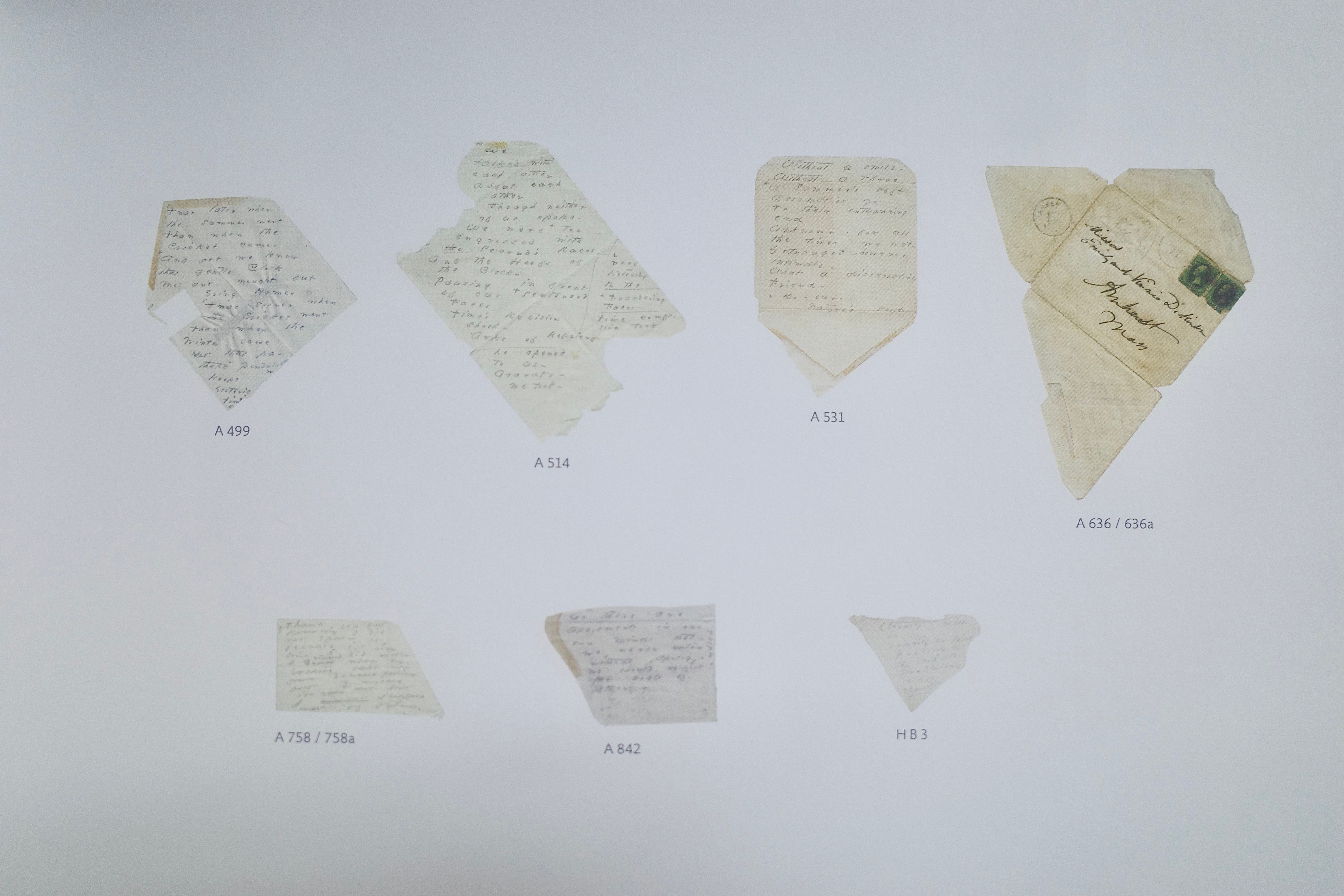
Her envelope poems were potentially written in a feverish burst, the paper grabbed at from a source nearby, creating a palimpsest. Naturally, many of her poems are written on clean square cuts of paper, too, as the Dickinsons were of generous means. Still, I focus on the envelopes because they fascinate me. The word “envelope” simply means to cover. A sense of passion and secrecy marks both of these movements.
The lines on the envelope poems are beginnings or endings of future poems, micro letters, and independent poems. They exist as they are or as an infinite ellipsis. The handwriting looks like “the fossil-tracks of birds”5 according to the previously mentioned correspondent, Higginson, and I agree. Her work is primarily in ink, but you see a shift to pencil from 1864 to 1865. During such a time, ink was cumbersome, involving multiple tools, whereas a pencil could be tucked into a garment. She famously only wore white in her later years, a simple dress without a corseted waist—shocking for her time—and had a large pocket sewn into the right side, an ideal situation for a pencil and some envelope poems. On the “left wing” of some of the envelopes, one can find a pinprick from where she’d sewn a few together as a sort of chapbook.
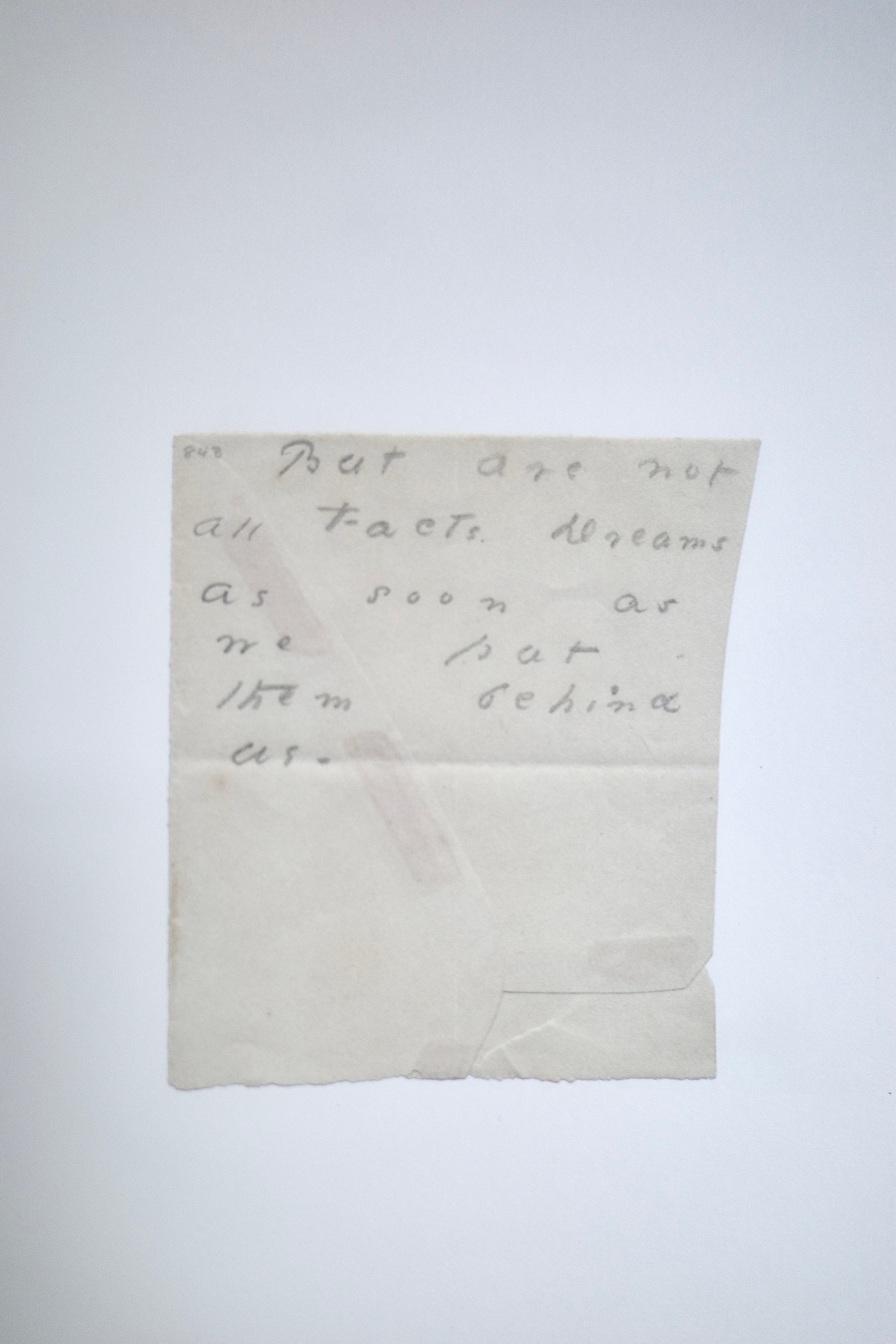
In braiding together her love of concealment and seclusion, one can see an artist who truly lived for the work, for mastery. Her rejection of professional attention brought her peace. I’m deeply inspired by Emily’s effective brevity, her sense of play with form, and her ability to report on mortality from a place of wonder. Even with her seclusion and narrow experience of the physical world, her poems pulse with life. In the poem below, she presents a question, but she shrugs off a question mark, instead plugging in her grammatical love: the em dash. While the mark may appear as a period to the quick eye, one can note its centered placement, and all print materials reflect an em dash over a hyphen. In providing us not with a question mark but a “break,” she allows a stronger possibility; she welcomes us into the negative space.
“But are not all Facts Dreams
as soon as
we put
them behind
us —”
All of the envelope poems seen here are printed in The Gorgeous Nothings: Emily Dickinson’s Envelope Poems. The originals of these pages are owned by the Harvard Library and can be seen there, the core of which includes her handsewn poems alongside botanical pressings, letters, and family artifacts.
One may also visit her house and the family cemetery in Amherst, MA. Additional artifacts are stored at Brown University, Yale University, Amherst College, Amherst Historical Society, and the Boston Public Library.
For further reading, Open Me Carefully: Emily Dickinson's Intimate Letters to Susan Huntington Dickinson is an excellent resource.
Emily Dickinson to Mrs. Josiah Gilbert [Elizabeth] Holland, in a letter dated early 1884, reprinted in Vol. 3, Letters, 811.
The Emily Dickinson Museum, Cultural Landscape Report, prepared by Martha Lyon Landscape Architecture, LLC, 2009, unpublished, 11.
Discovered through Xiao Situ’s “Emily Dickinson and the Poetics of Glass” in the University of Delaware’s 2012 Material Culture Symposium, 1.
Thomas Wentworth Higginson, The Magnificent Activist: The Writings of Thomas Wentworth Higginson, 1823-1911, edited by Howard N. Mayer (Cambridge, MA: Da Capo Press, 2000), 544.