LE SUD
Appetite & Awe: Provence-Alpes-Côte d'Azur

“I cannot count the good people I know who, to my mind, would be even better if they bent their spirits to the study of their own hungers.”
― M.F.K. Fisher, How to Cook a Wolf
Recommend a place for me to travel to, and I’ll research its off-season; I have a penchant for the honest groans and unexpected glitter of a city in repose. Give me the high water and trembling café umbrellas of Venice in November or even my own city, New Orleans, in the summer when most have fled, leaving behind uncrowded pools, cicada song, and kitchen sinks reappointed with ice, oysters, canned beer, and sweating bottles of rosé.
Last summer, in an effort to manage wanderlust and forever a student of my own hungers, I knew I wanted to touch down on some vineyards. I had been feeling a pull toward Languedoc-Roussillon—particularly the work of the winemakers behind Clos Fantine—which amplified when I learned about the November truffle season and the ochre landscape of Le Sentier Des Ocres. I could fly into Nice and flirt with the Côte d'Azur, catching a chillier Mediterranean, but more importantly, the land that brings forward Domaine Tempier, Clos Cibonne, Domaine Les Terres Promises, among other winemakers I’d been tracking for some time. So, yes, I began charting a tour of Le Sud, the south, in its entirety.
I collected a dizzying array of trails, markets, sites, and vineyards to consume. A journey dares you to narrow down the essential, a test that has no key, as the outcome is variable for any given human. The puzzle of memory is that the experience of a moment or given place can be many notes—radiant, unsettled, mundane, elated—but only in reflection, beyond the actual, do we define it, and here I shall do my level best.
Roussillon
I arrived in Roussillon at sunset after a long drive of contrasts: the neoclassical and art deco color pop of Nice, Aix-en-Provence with its urban sprawl, the countless vineyards and rolling farmland beyond, the thick expanse of emerald treeline hugging Luberon Massif, and the faded denim sky where the oncoming golden hour was less an overall effect but rather a daily trick of clouds infused with orange and pink.
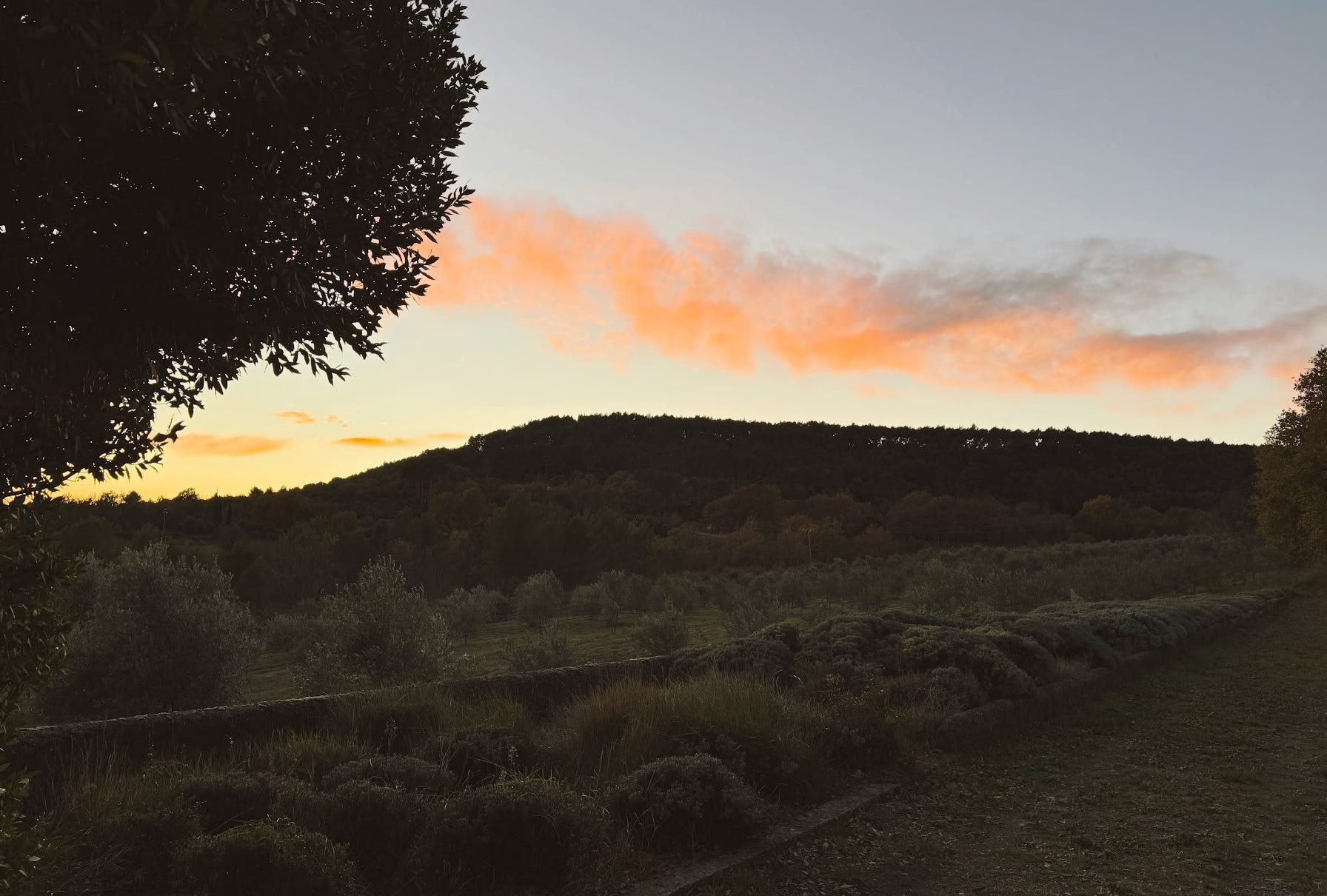
The Rhône River, similar to the Mississippi here where I live, divides southern France into its eastern and western regions. The right is the cinematic idea of France and is home to film festivals, lavender festivals, and sunbaked splendor. The left—Languedoc-Roussillon—is not the picture of wealth, though beautiful in its unfiltered scrubby earthen honesty, what with its farming, commercial fishing, and more sights of vineyards than human life.
After a multi-stop itinerary, the way of traveling to smaller European cities, I couldn’t imagine driving again, not even to a market, and betrayed my best interests and travel goals, dining on oats I’d packed as they are the sustained energy hero for dancers, writers, and hikers—parts I play in turns. The rental I’d chosen was exactly what I longed for, a modern wooden chalet painted black, ensconced in so many pines and oaks. It was fine, by me, to chase the thrill of a hot shower and early bedtime, knowing my morning held plans of Le Sentier des Ocres and the inner commune of Roussillon.
Le Sentier des Ocres
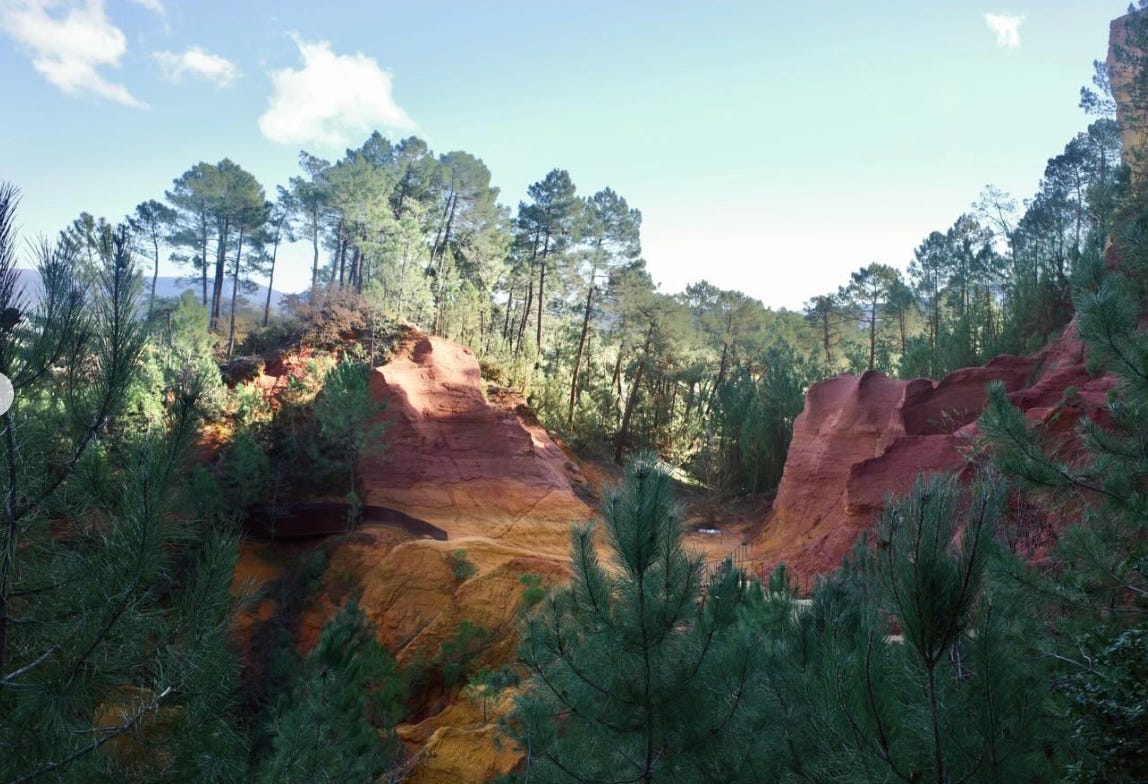
Once an ochre mine, Le Sentier des Ocres, or The Ochre Trail, is a canyon of ridges, cliffs, and waves of elevation. These ochre landscapes have been shaped by two centuries of wind, rain, and human treading.
Ochre sand is developed from iron-rich sand deposited from the sea centuries ago. The tropical climate enables a chemical reaction, creating kaolinite, which oxidizes iron, resulting in the intensification of warm hues. As the light changes, so does the saturation of color; the autumnal light placed deeper resonance on the reds. I’ve been drawn to color for some time; it may date back to the particular delight I found in mixing gouache to achieve “fuchsia” in my college color theory class, studying the effect of color and therein, light on the mind. Last year, I was particularly drawn to blue, but this year, I’m drawn to red. Humbled beneath so much of it, I found the sensation of it ardent and vital rather than aggressive.
The canyon was quiet—the chatter of wind and birds—and the occasional ringing of the bells from Eglise Saint Michel. In contrast to the warm hues, I passed through green groves of Maritime Oaks, Cypresses, and Holm Oaks. The trails themselves were packed clay, occasionally brightened by red valerian and marigolds. It was an awe-inducing sight to take in the varying hues against these contrasts, to know a reverence for nature from its resilient and unfixed beauty.
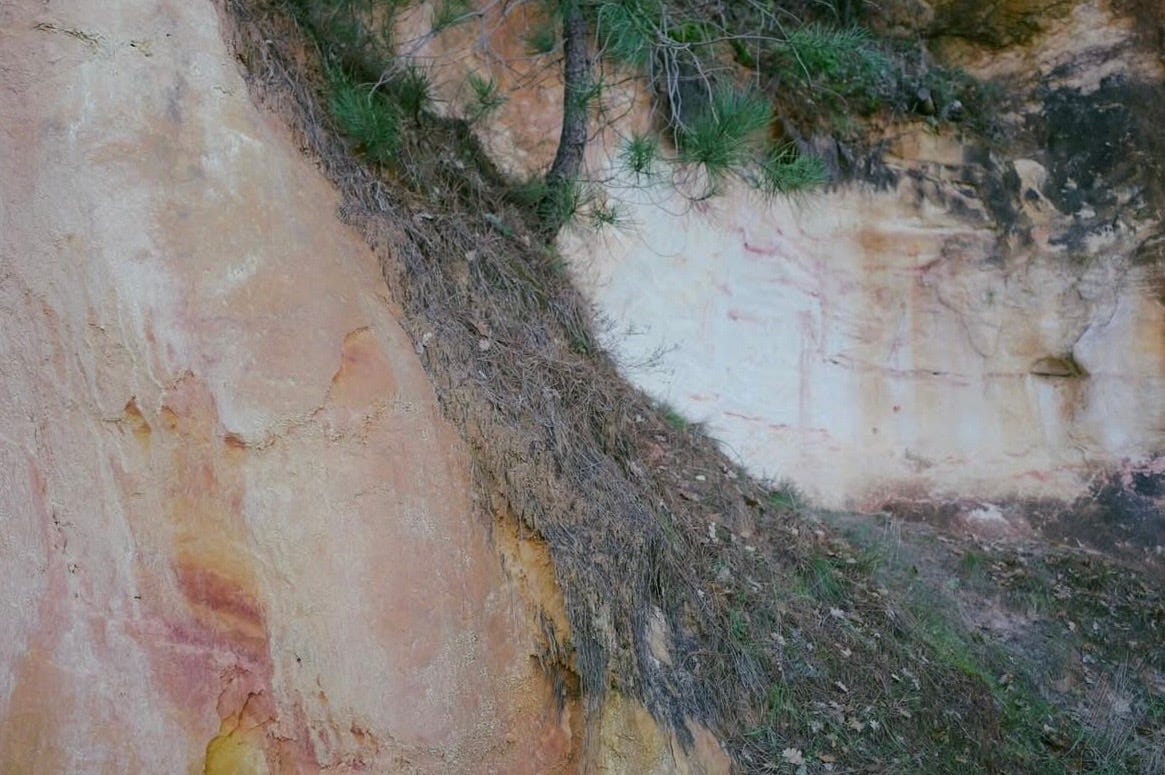
Hikers can go on a brisk thirty-minute hike or one hour; I chose the latter, but then repeated myself, the second round putting my camera away and just savoring it all, thinking, wanting to remain in a nature-led fugue state. There can be a profound difference between strictly following markers and moving aimlessly, which may come with trust in the trailheads and easy trails like this one. The psychological effect of walking without a goal versus a destination is vastly superior, a release rather than an effort. Only hunger and a feline guide would have the power to nudge me from the canyon.
Roussillon
After Sentier des Ocres, I followed a grey tabby into the winding, hilly streets of Roussillon, where it was easy to get a café crème and jambon-beurre—ham and butter on a crusty baguette—and take in even more colorscape as if awe hadn’t threaded itself into my every nerve already. The commune is a palette of warm-hued ochre: brick reds, dusty pinks, and sun-baked yellows. The narrow twisting streets are mostly residential but also host many art galleries and cafes. Some structures contrast their ochre foundation with cool-toned shutters, while others stay within the palette, featuring a red door bright against a faded peach body.
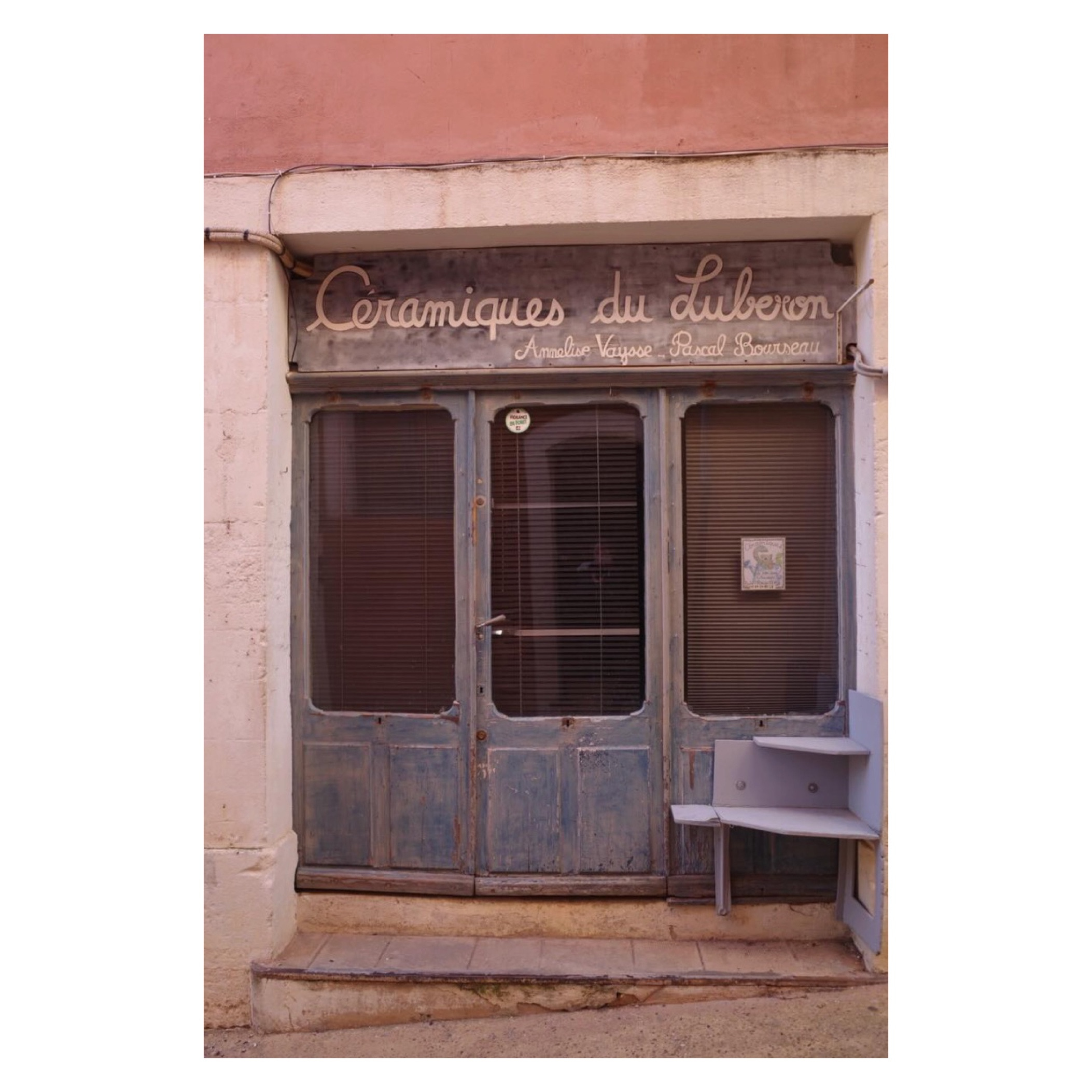
As it was off-season, the streets were quiet, many shops closed, lending an alternate reality, the painterly beauty of architecture without people. That is not to say the evening cafe scene and crowds on market day aren’t without their lively brights, but there is a certain bedhead beauty to the unanimated hours of a place. The cats were happy.
Truffle Hunting
I can’t tell you where exactly I foraged for truffles because it was forbidden by my hosts. Theft is so common that farmers often electrify fencing to keep intruders out.
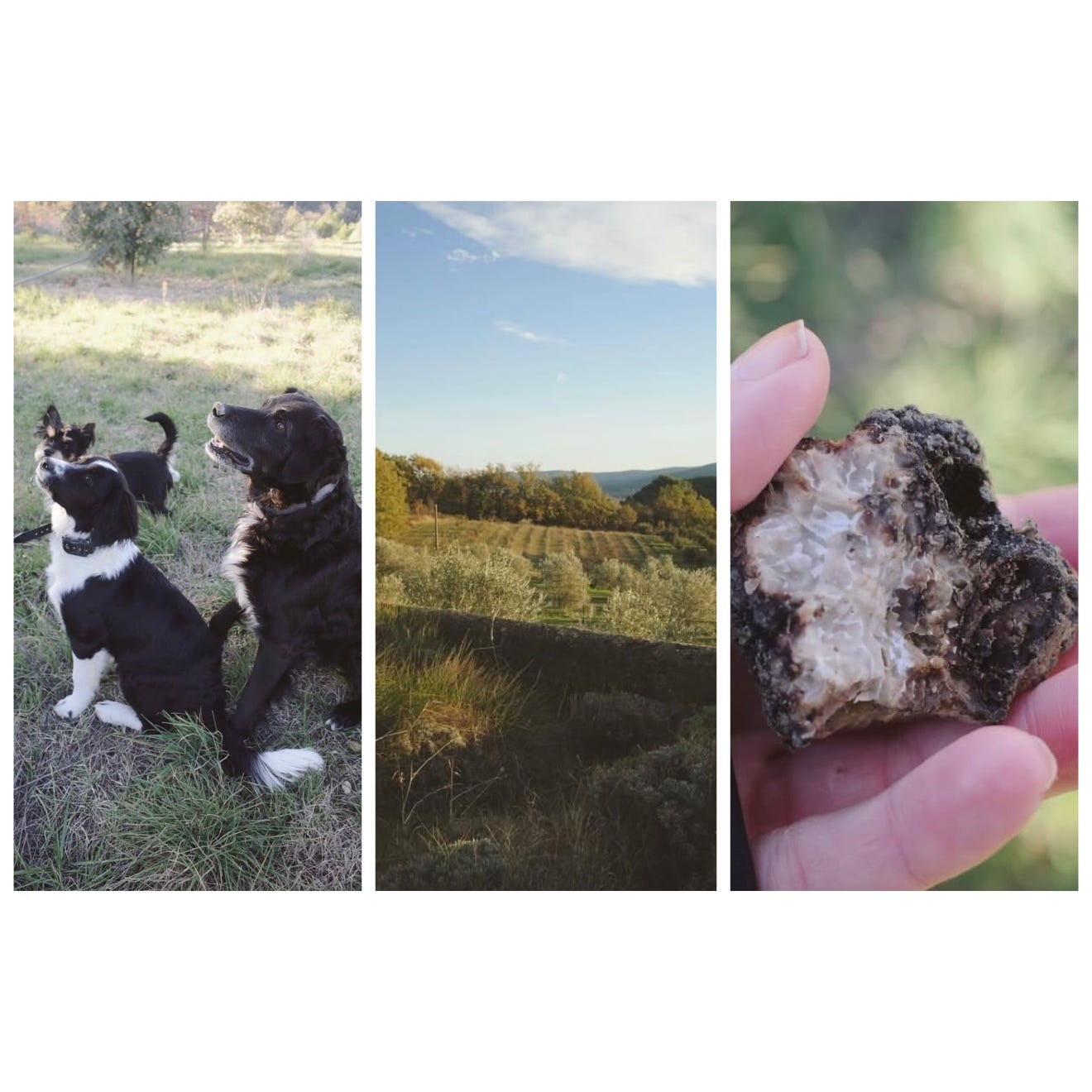
While for a great swath of history, pigs did the truffle hunting, the work has been handed to dogs, who are, remarkably, less likely to eat the truffles. The dogs start their shift racing into the olive grove, first seeking a hundred or so pets, before scurrying from tree to tree for a good sniff.
Truffles are a natural occurrence underground, and olive trees are an excellent host as they lend fungus with essential sugars from photosynthesis to the truffle. A symbiotic relationship evolves as the truffle provides the tree with essential nutrients such as phosphorus, helping the tree absorb more water.
As for the process, that day, once a dog latched onto a scent and dug their paws deep, one of us would lovingly shoo the pup away and carefully dig out the truffle from the soil. The dogs are more likely to destroy it…because paws. Particularly the border collie pup, After, named for his birth during an epic afterparty. He zoomed himself into body flips fairly often, so I wouldn’t trust him with delicacies. Absurdly cute, as were the others, he held court with a regal black Labrador, Foudre (or lightning), and a terrier whose name I genuinely have forgotten because she was most commonly referred to as Asshole—but she was the best at the work if not affectionate to human life.
After the hunt, we returned to the house where the umami-rich truffles we’d secured were prepared in various ways: shaved over bread, then butter and bread, onto a triangular cut of nutty, sharp Parmesan, and a scoop of ice cream with a drizzle of local honey. All of these tiny, decadent bites were accompanied by Champagne. Only upon the shaving of the truffle could I learn the trademarks of the Provençal tuber melanosporum, which is a marbled design with white veins, never a uniform expanse of color. A true truffle is rich but subtle and smells like the earth after a rain. So many oils, and expensive ones, on our grocery shelves are artificially flavored; brands do disclose this fact, but few read their labels closely. No matter how beautiful the packaging, you need to see some truffle bits and just good olive oil for it to be the real thing.
My anonymous host was crass and warm and wonderful. Once the truffle knowledge was exhausted, I asked him how he met his wife, and we proceeded to banter, as best one can when not fluent in another’s language, about Seinfeld. A Frenchman by birth, he was unlucky in love until he moved to the Midwest. There, his accent and humor—developed from binging the work of Larry David—had power over some American hearts, whereas it only repelled the French women he tried to date. Between the digs, we passed back favorite episodes: “The Marine Biologist,” “The Jimmy,” and “The Pothole.” Yes, my host met the love of his life in Illinois and brought her back to France.
One can never know that so many mundane evenings and lunch breaks I’ve spent watching Seinfeld could be a greater lingual and community healer than most efforts, or that an extravagant excursion such as truffle hunting could be grounded in the comedy of second-hand embarrassment and shortcomings.
Seeking Albert Camus
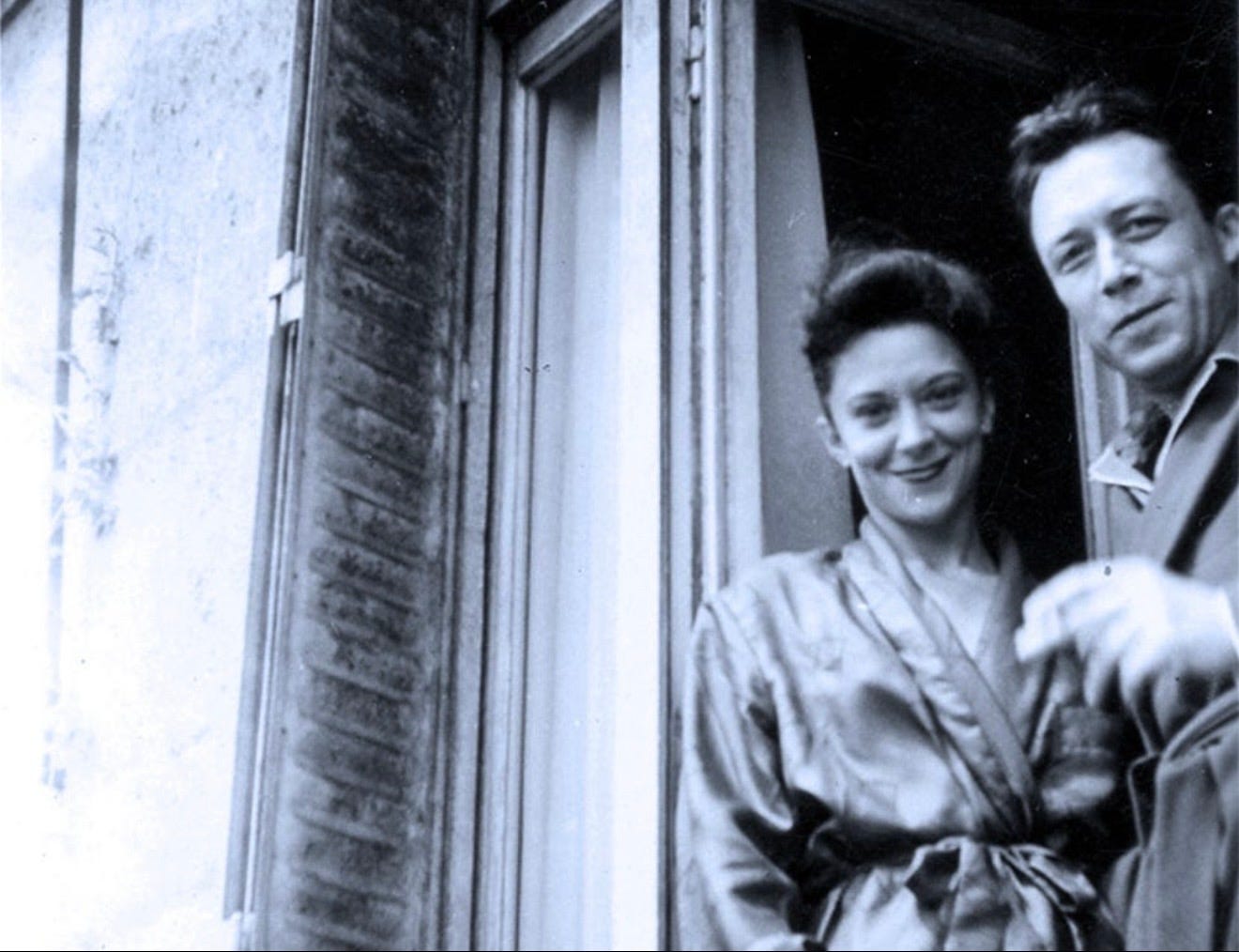
The morning of Thanksgiving, I typed my friend’s location in Bandol and discovered that I would pass the gravesite of Albert Camus in Lourmarin with no added time. I would have to be lazy not to stop, and I am not that; rather, I am overeager. I added that stop, revisiting the work of Camus in my mind en route; there was The Stranger first being fed from a Discman into my ears via The Cure then on to an actual reading in my existential philosophy class in college, and that time I put down my copy of The First Man—ravenous after reading his effortless little bit about French fries in a paper cone shared among friends—and I proceeded to slice potatoes then fry them, even whipping up an aioli. There is a dark, sultry element to Camus, an association of danger because he’s so interested in telling the truth flatly. What a human expansion it is to move beyond discomfort into interest into revelation. Or, this is what his words have done for me.
Upon arrival at the pinned site of Camus’ grave, there was nowhere to park, just a narrow road and an older man approaching me with irritation. I parked on the road, little stones flying in disarray around my tires. Outside the car, I noted a gated, overgrown lot, where the grave might be, and the older man stood in front of it. No effort of communication needed to be made when I met his gaze; he was agitated. I spoke my scrappy French, but for clarity, I asked the question below, which I’ll present in English:
“Hello, sir. I’m looking for Camus’ grave. Do you know if it’s over there?”
One thing in France is that no one tells you that you can speak English; they just start speaking it, a sort of lack of pleasantry that is rather economical in time and doesn’t bother me in the slightest.
“No, no.” He threw his hands in the air. Silence. I was certain the map pin was an error, and I should leave, but he spoke, “Madame, you wouldn’t understand. It would be meaningless. Go drink some wine. It’s everywhere!”
He gestured toward the near and far reaches of vineyards before he shooed me toward the car. I walked away from him, both amused and perplexed. Why was he the authority? And yet, I didn’t feel the need to fight him either. My disappointment quickly twisted up into a smile. Once I was back inside my car and belted, he patted my window, pleased that I was leaving.
I looked at where the gravesite could be as I turned the car around. The old man watched, my face still locked in amusement that likely miffed him. Maybe I wouldn’t understand. Maybe like the ideas in Camus’ writings, it would indeed be meaningless to bring my gift of honor to a long-gone man. The ground was just dirt and stone, and the sky was ever-changing. A simple truth settled: what I’d come for that morning didn’t matter any longer. Je suis partie avec son esprit. I left with his spirit.
“There is no situation involving some physical constraint which does not give rise to dreams of wine.”
Barthes, Mythologies
Bandol
I opened the blue iron gate that led to my friend’s rental in a state of absolute thirst. Not for water, no; I wanted wine. When I’d texted my arrival estimate, she’d sent me the kind of text that hits like a double espresso shot, “We’re here peeling potatoes and drinking Tempier Blanc.” Food prep, an elastic timeframe dinner party, and place-appropriate wine are an overwhelming wonder trinity. I really can’t explain to anyone who doesn’t understand how wonderful it is to drink wine and peel potatoes with people you love.
We convened to celebrate a milestone birthday, firstly, and Thanksgiving, secondly. I had no way of knowing how a journey from New Orleans to the South of France with its many legs, compounded by the character-building work that is driving through the mountains of France, would all resonate in my body; I was vibrating, at a level more aligned with alarm than elation. I was Barthes. I needed a glass of wine and the sea. To start.
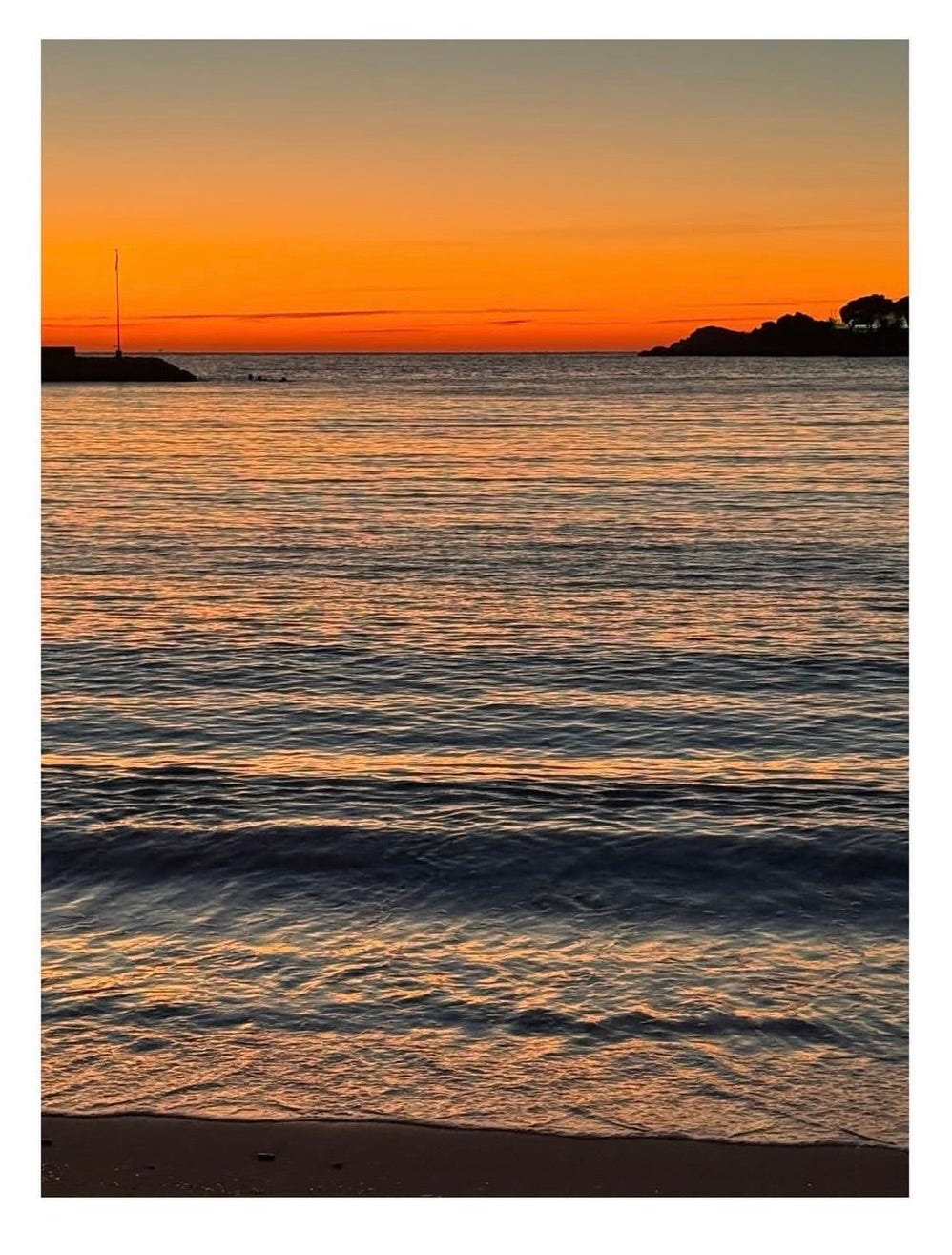
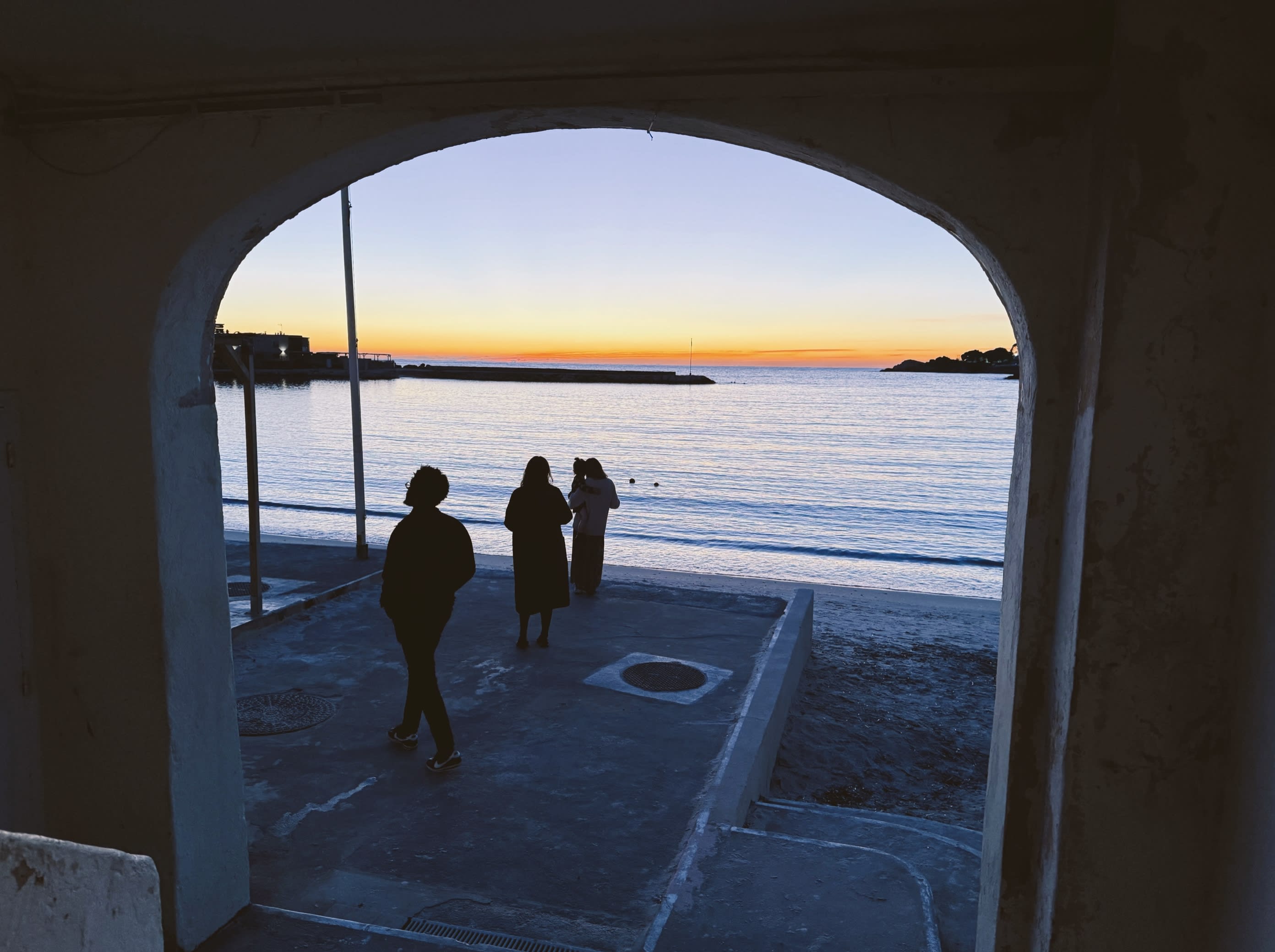
Soon soothed by sea spray, Tempier Blanc, and conversation, I joined the crowded kitchen while a new friend—also a chef and stylist—directed the meal effort. To be honest, as the latest arriving guest, my work was centered more on entertaining a little girl, which I was eager for. I missed my own boy and gravitate toward children for their robust energy and talking points: dinosaurs, ghosts, and fairies. Just before dinner, a round of mini-martinis appeared. We threw on sweaters to walk to a nearby viewpoint, glasses in hand, as we cruised the narrow streets of Bandol. After descending graffiti-tagged stairs, we turned a corner where the sky suddenly appeared. An unreal sunset dropped, a landscape of perfect complementary colors, naval orange against a steely blue.
I was informed of a little wine game ahead in which, by the night’s end, we’d decide what grape everyone most resembled, an act that felt both clairvoyant and artful as a prose poem; I loved every minute of it. As for grape alter egos, everyone wanted to be Nebbiolo, which is essentially beauty, but there was only one lucky recipient. Other grapes thrown in the mix included the volcanic Nero d’Avola, the rustic chameleon that is Sangiovese, the unhurried stunner that is Mourvèdre, and Cinsault, the darling and bright jewel of Roussillon. I was named a Cabernet Franc, a grape that shines as well on its own as with others (say, especially, a Right Bank Bordeaux) and manages to be complex and soft. As we shared our casting, we dined on escargot, duck with currants, truffled (I delivered) green beans with mushrooms, mashed potatoes, greens, and all the cheeses from firm and salty to pungent and oozing.
We drank generously but slowly that evening, considering pairings, certainly. Moreso, we were studious, doing my favorite move of opening several bottles for slow consumption. Like a captivating person, and I was surrounded by them on this night, a great wine can bang around the glass, showing itself in layers if you give it time. We drank the bottles in tasting pours, noting the exhibition of notes as they flowed in and out. I should clarify that there were many bottles: Châteauneuf-du-Pape, Aligoté, Mourvèdre, Roussanne, a Burgundian Chardonnay from Mersault, among others. Reflecting on the 2011 Domaine Tempier La Migoua, a Mourvèdre-led blend, I understood why the great writer Jim Harrison said that the wines produced by Domaine Tempier could "fight off the night in our souls." Harrison was friends with their distributor, Kermit Lynch, and the bottles show up in his essays, particularly the collection, A Really Big Lunch. La Migoua has all my electricity words—garrigue, stony, gamey—and feels alive. This bottle demanded I shut my eyes and feel it.
“The sun is a thief: she lures the sea
and robs it. The moon is a thief:
he steals his silvery light from the sun.
The sea is a thief: it dissolves the moon.”
― Vladimir Nabokov, Pale Fire
Clos Cibonne
When we arrived in Le Pradet at Clos Cibonne, there was confusion about the appointment time, so we hydrated and ate exquisite, pungent cheese and ham-stuffed baguettes, our bodies resting against the trunks of our cars. Most any day can be gorgeous if you’re in the right spirits, but this day was textbook for its warm sun and gentle breeze that would appear just when I’d push up my sweater sleeves.
I walked through the post-harvest rows and pathways, over slate and clay soil, picking up glittering quartz, sea glass, tile, and ceramic shards. The Mediterranean Sea was near, though not in sight, throwing out its sea spray over the 18th-century vines, and one could clearly see the mountains of Saint-Baume National Park.
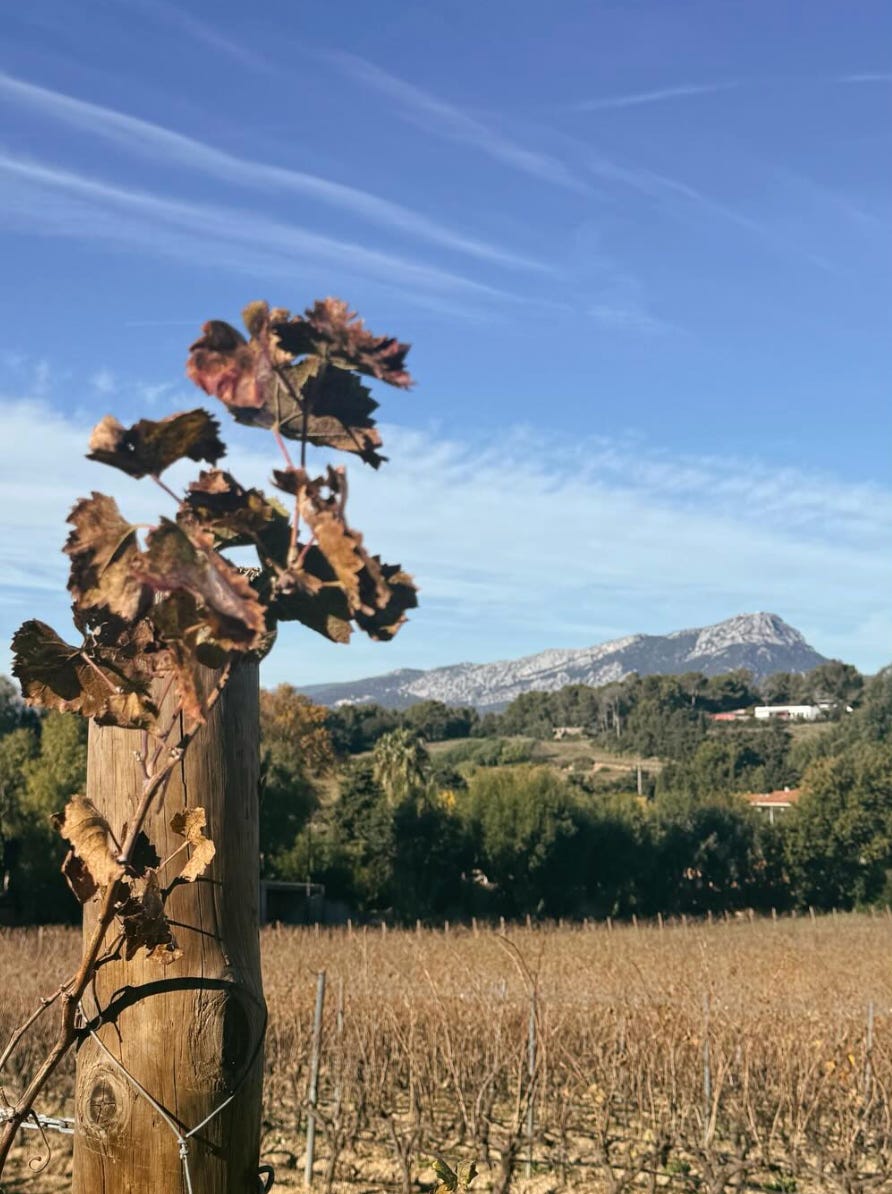
After we self-toured, we went inside for a tasting and tour of the foudre casks. Known for making one of the most strikingly beautiful and unusual rosé bottlings, vintage after vintage, Clos Cibonne works persistently with Tibouren. I don’t reach for rosé so often, as so many can be one-note, but grape choices like Sangiovese or certainly Tibouren always intrigue me. You get the earth in this rosé from the late flor aging (similar to what we see with sherry flor) in century-old foudre beer casks from Alsace. The most recent vintage of the rosé is a blood orange, thyme, and umami dream, thanks to all that the yeast imparts. We wanted to see the flor but we had to settle for the exterior nearness, the chalk-scrawled label, the mystery.
The low-juice yield and difficult Tibouren grape shine in Clos Cibonne’s work, but they also utilize Grenache, Cinsault, and Syrah. We tasted a tiny-production red I’ve never had access to in the US, the Tradition Tibouren, which has a touch of Grenache and is a wintry rush of garrigue, bacon, currant, and cherries. A bottle for fireside chats, a good book, and braised meats, I took one for a near and much-desired slow day.
Avignon
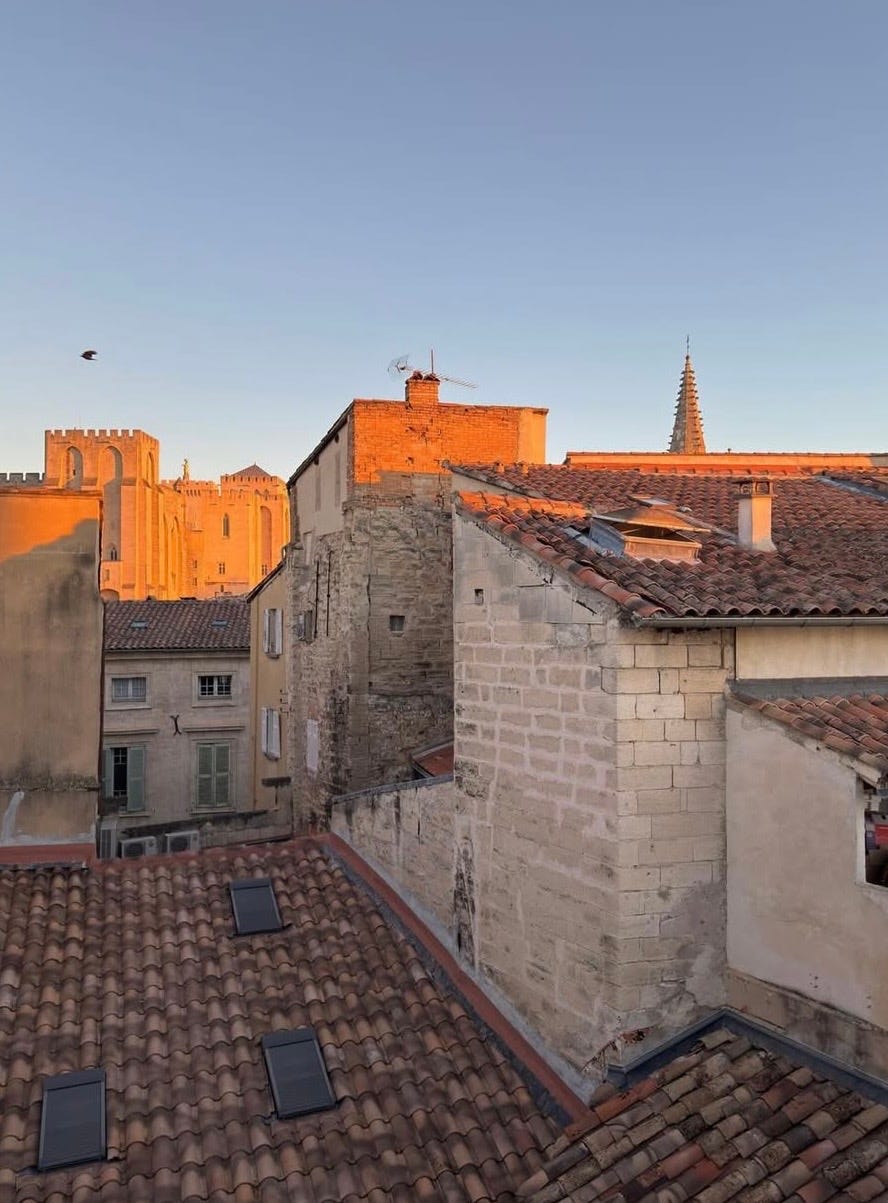
While in Le Sud, I had a talent for arriving at sunset. Approaching Avignon, the sun began its warm descent over the Rhône River, along which I drove in parallel until entering the commune. The sudden reveal of Avignon is a surreal scene unless you are comfortable with medieval stone ramparts as your home base. It is small and winding, much in the way of Venice, but far more stern and neutral in palette. Once secure in my attic-floor perch, the sun spotlighted the terracotta barrel tiles, their rows ignited as so many peaches glowing a hot orange.
When I woke the next morning, my body was still unable to relax from the consistent days of motion. I had no food or coffee, so I took a walk, first to feel the sensation of the place, still quiet, the stores just opening. Then I stopped at a market to buy groceries to fuel a slow day, settling on arugula, eggs, butter, bread, and blackberry confiture, but more importantly, all the bits for steak au poivre, which is one of those handful of dishes I can make without a recipe, and trusting that the Clos Cibonne Tradition Rouge and a little sherry would elevate anything.
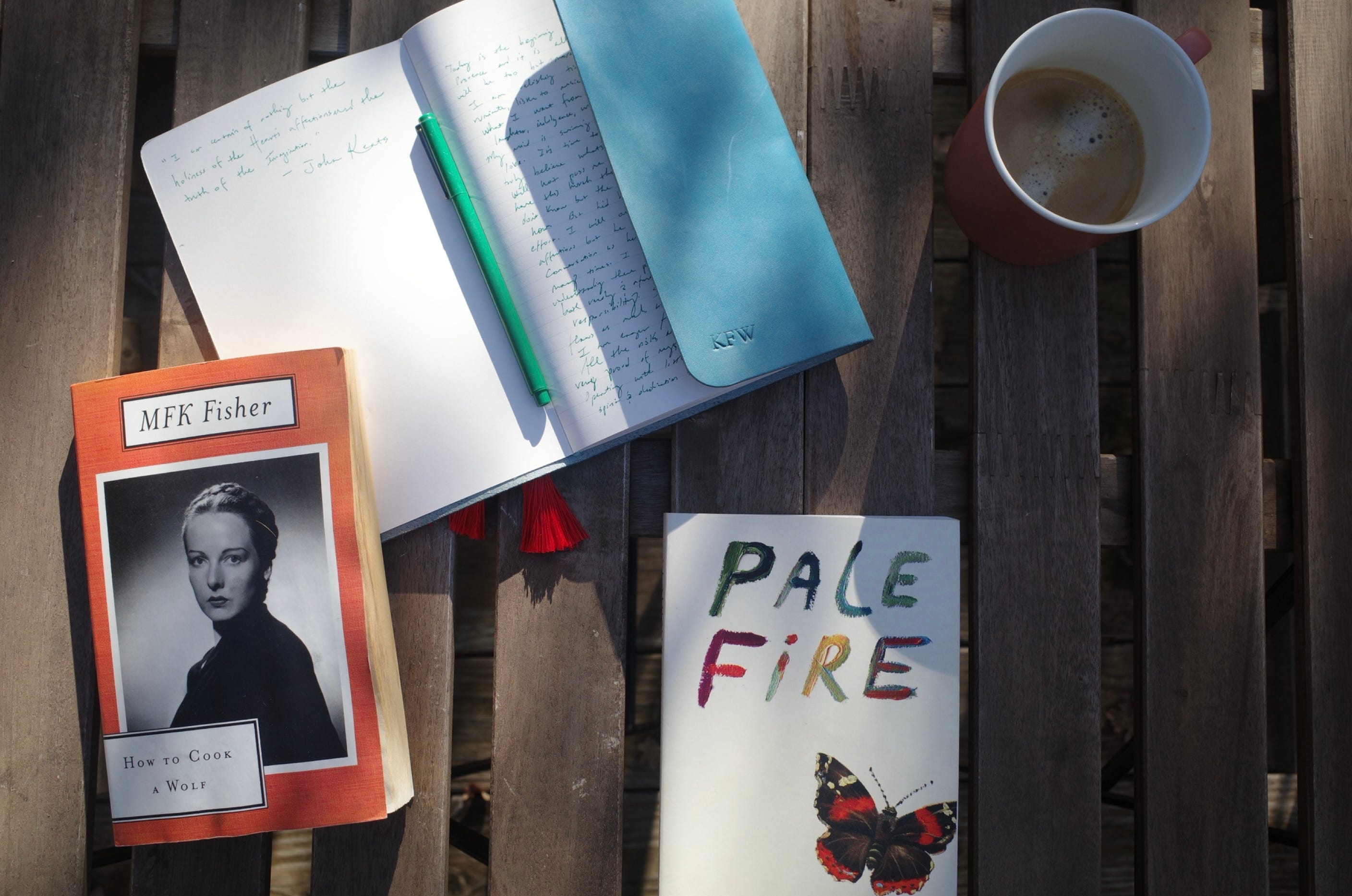
That day would be defined by calm. I managed a near hour of quiet barre flow—pliés, tendus, dégagés, rond de jambes, and adagio—to center my breath and stretch it all out before journaling, and rereading How to Cook a Wolf by M.F.K. Fisher.
While it was November, it was moderate, and I was able to open the windows, letting the periodic bells of the Palais des Papes energize the silence and remind me of the place, this village defined by its spiritual intention. I thought a great deal of Joseph Campbell’s The Power of Myth while in Avignon: “You can tell what’s informing a society by what the tallest building is.” Here was this commune of nice light and lines where the spiritual flowed from its medieval papal center. To be within the Palais des Papes was somehow dissociative and cold for me as a visitor; the romance of history was better felt walking the old, winding streets with their haunting echo of quarter-hour bells and children at play in the squares.
Clos Fantine
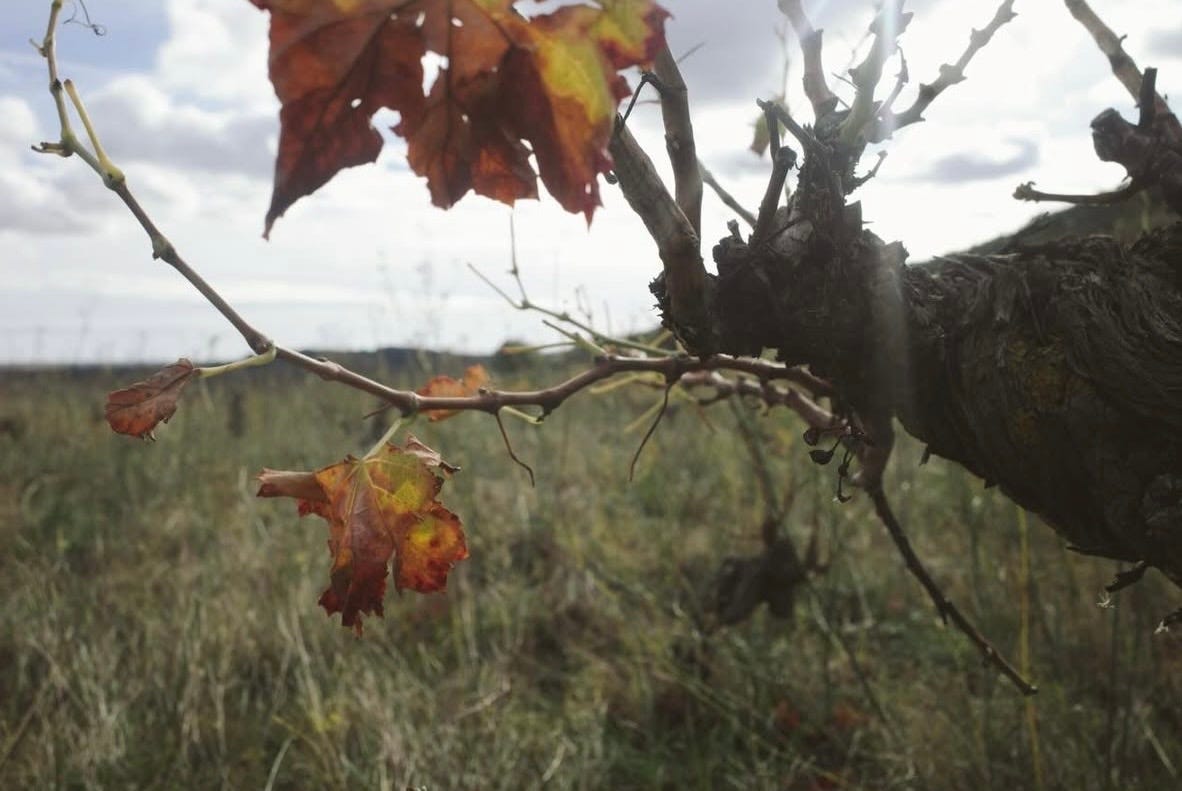
Before arrival in the commune of Cabrerolles in the Faugères AOC, I was very lost. The vineyard, quite simply, was not pinned correctly to any map. I called the vineyard line, and an American man named Richard was put on; he spoke perfect English and was spending time with the winemakers, not to study wine but to build a stone wall that would stretch along the entrance. With his wayfinding playing in my mind as a shuffling deck of photographs, I drove tiny winding roads with fennel swaying before a wild landscape beyond. Vineyards approached that were unplowed, mostly bush/gobelet trained. Slabs of exposed schist were present at the entry alongside the unfinished stone wall.
Clos Fantine is a vineyard led by siblings. I spent the bulk of my time with Corine Andrieu. We worked through garrigue-rich terroir—bushy formations of sage, lavender, thyme—and she pointed to oak trees in the distance, explaining how they bring shade and deter fierce winds from the north. Our hands pulled up all manner of growth, studying the soil, fungi, and ant colonies. Further along, into the vines, I munched on arugula from the source while scanning the sprawling, hilly landscape that also raises Mourvèdre, Syrah, Cinsault, and Terret Gris, among others.
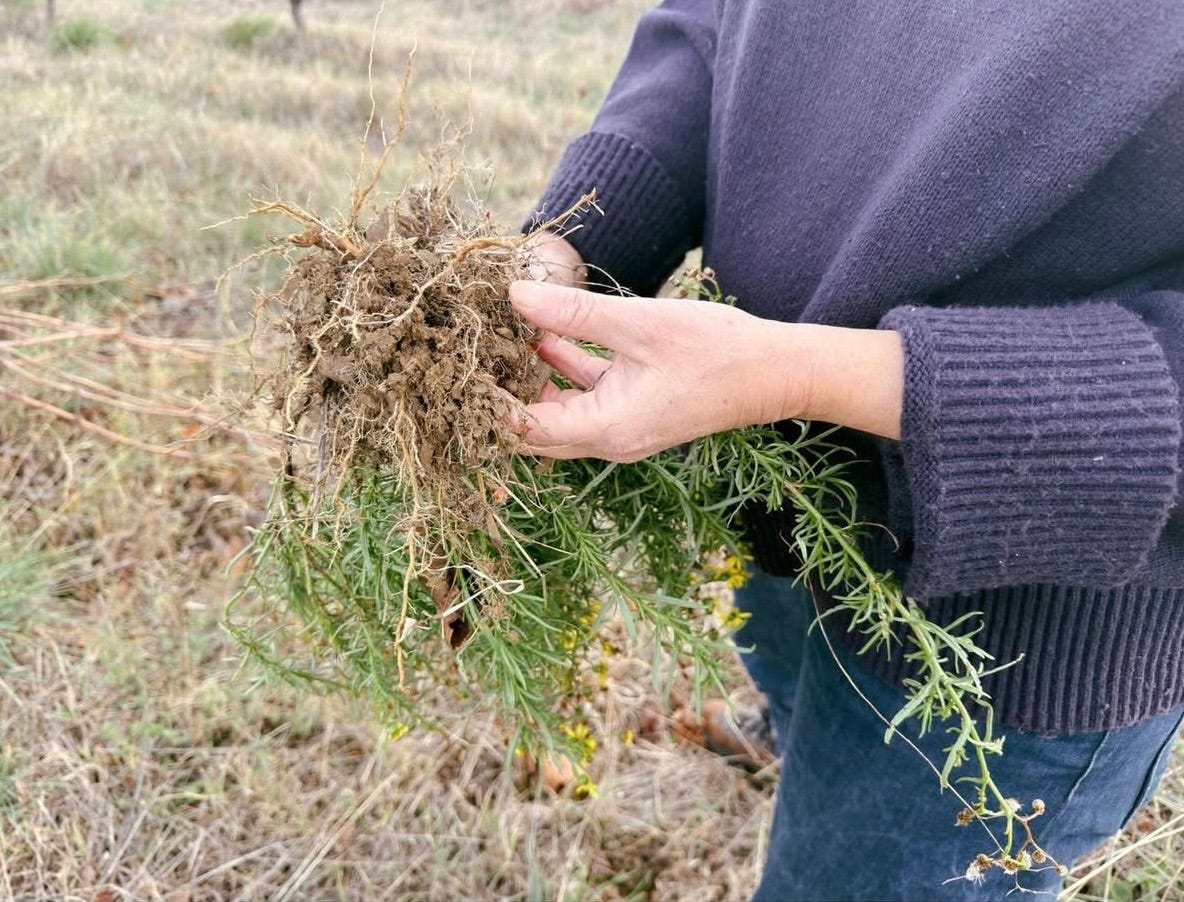
Agriculture is where I get knowledge-hungry and source the romance of wine; in this work, everything is always in flux against the elements, and we have climate change, but there is an imprint of place if you pay attention. Clos Fantine are masters of Carignan, a rustic grape that elicits a thrill in my heart when it comes together. I direct the wine program of a restaurant in New Orleans, and the Cuvée Tradition is transportive for tables. The 2020 vintage of Cuvée Tradition, starring Carignan and Grenache, is a palate portal to the terroir I met: dusty thyme shoots and sage scrub, cherries, stony acidity, and a lick of salt from the Mediterranean.
After crawling the terroir of Cabrerolles, we tasted new and old vintages, the new soothed in steel and concrete to the vibrations of an ambient score, and on we went to a hearty meal and fireside conversation. From the hands-in-the-soil sensory understanding of their vines, to tasting near-vintage wines with analysis of flaws and assets, and onto a meal and fireside conversation, this was one of those experiences that still cuts into my thoughts. These bottles are transparent vessels that work slowly, through the palate, to tell you where they are from.
Nice
“So it happens that when I write of hunger, I am really writing about love and the hunger for it, and warmth and the love of it and the hunger for it… and then the warmth and richness and fine reality of hunger satisfied… and it is all one.”
― M.F.K. Fisher, The Art of Eating
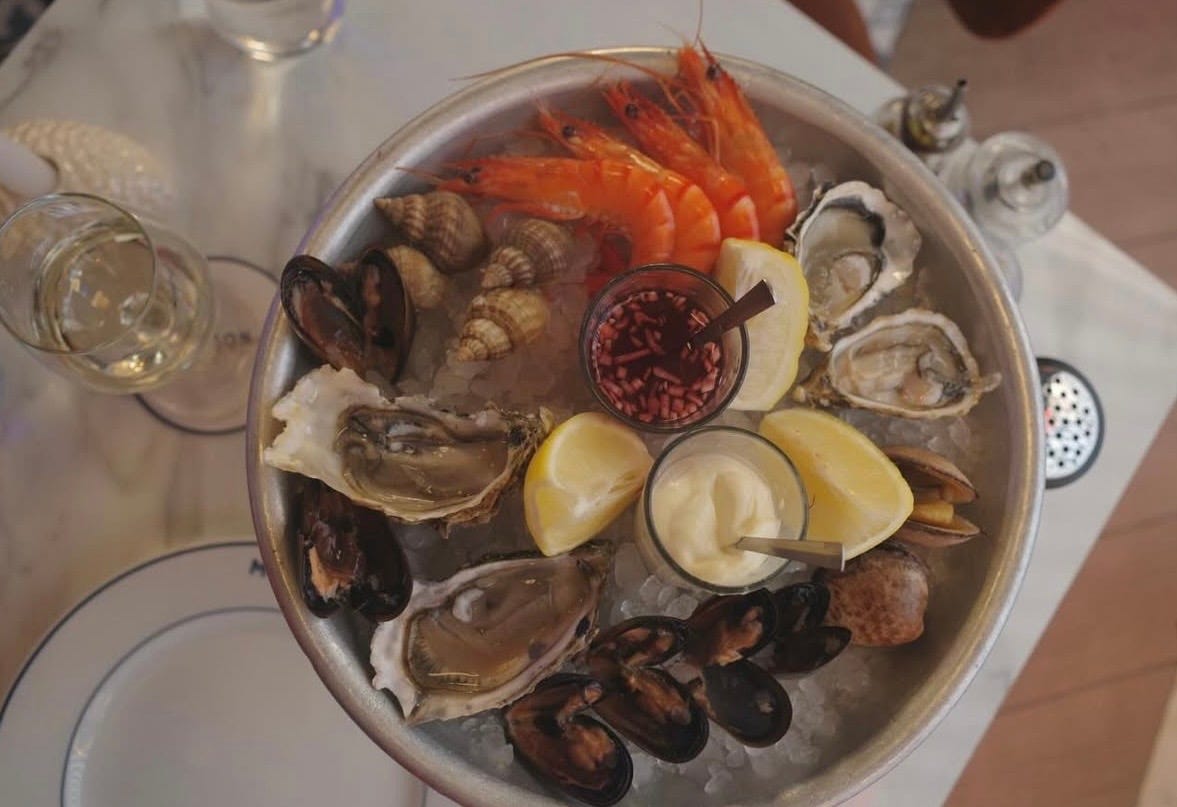
For better or worse, my last day in Nice felt delicious and homey. It was my great joy to valet my car and check into a hotel room, then wander and eat. After a nap and a shower, I set out for a seafood tower that I paired with pesto linguine, a simple love elevated by a scattering of stracciatella di bufala, and a glass of zesty Picpoul de Pinet.
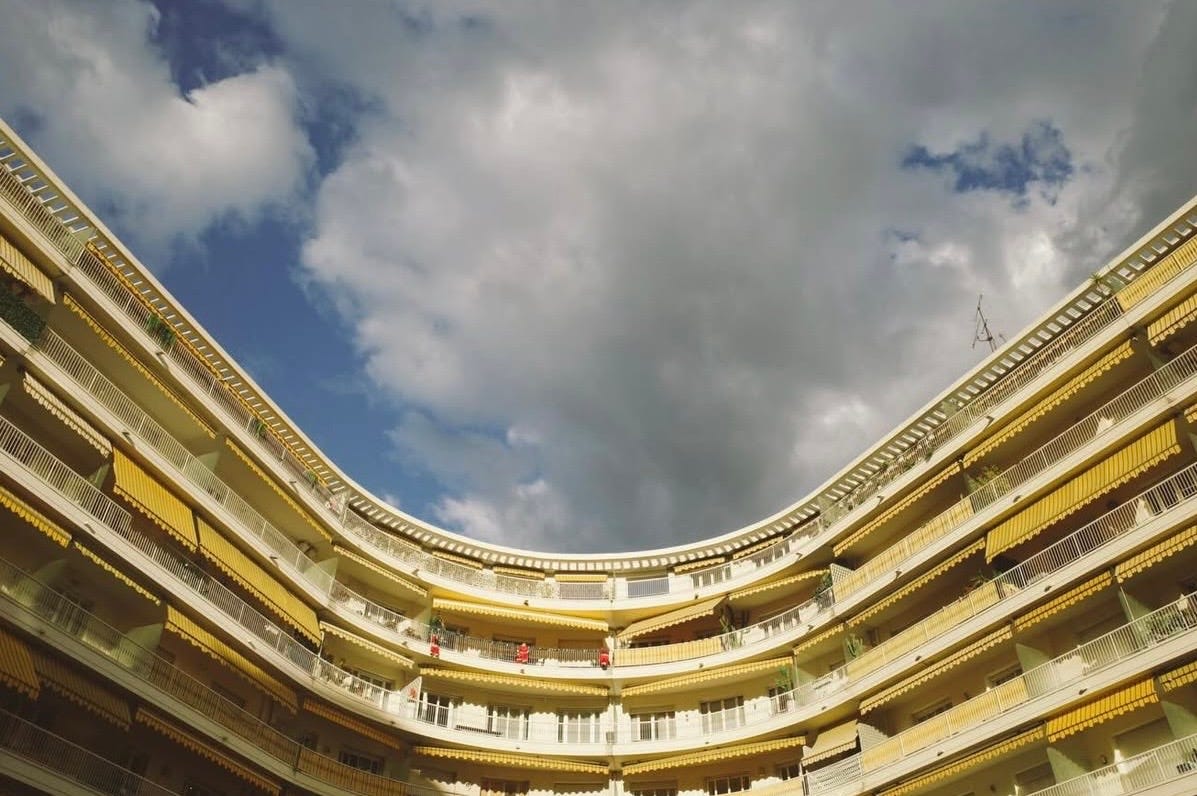
Nice is primarily yellow from its angular architectural shapes to its sunny stucco and awnings, and on to the very being of its Mediterranean light. Later, as the day cooled, I was perfectly stunned by all of that yellow against the purples of dusk. Banners crying Joyeuses Fêtes were suspended between the narrow streets, their lights igniting, and I received my first nudge into the light show that is Christmas. Evening fell, and I found a perfect bottle-shop wine bar where I savored a bright and savory Cinsault by Les Cigales dans la Fourmilière, which is impossible to find in the States.
On my walk back to the hotel, I had a second dinner because adventuring made me ravenous. Opting for vegetable tian with slices of tomatoes, zucchini, and eggplants, roasted in herbs de Provence, I succumbed to the traditional, and it was a worthy ride. Next, I cut into Chicken Provençal, which is a setup of wine-braised crispy legs that have simmered in heaps of garlic, shallots, olives, artichoke hearts, and little cherry tomatoes, all burst and wrinkled from the heat. I left French grapes behind, choosing a Langhe Nebbiolo. I hardly ever get days like this where I can improvise and dine and drink in little increments without theme or reason beyond basic pairing science or wants. So, on this lovely day in Nice, I reached for an earthen rose of a red in the glass, a beautiful last lap before the white sheets of evening.
The Lost Glove
When I was reading Vladimir Nabokov's Pale Fire along my journey, I slowed on this line: “The lost glove is happy.” Undercut as a silly proverb in the book, the quote resonated for its suggestion that the incomplete package is not necessarily defunct, though how many of us have disregarded a solo sock or glove as a mismatch or unusable?
The idea contributes that we can be incomplete and raw, but we are not static; in fact, from that place of aloneness, we are free to feel as many emotions as anyone. Solo traveling is an act of solitude that inevitably gets one thinking about relationships. A relationship is nourishing, but the periods of time in which we are without it may also contain happiness, and may also teach us how fortunate we are when we find a connection that feels healthy and expansive.
If you spend as much time as I did in a car, you can eventually translate what the hell the Cocteau Twins are singing about, and then what? I mostly thought a great deal about my heart, how good it felt, but also what I wanted for it. M.F.K Fisher’s connection of love and hunger resonated. I am so eager to get to know someone again. Just as I have no interest in being with someone merely for a societal standard of normal, I am also aware that loneliness has a tougher barb of late, and perhaps because I’ve reclaimed my appetite.
I am proud of my journey for its complications, its honest fulfillment of my core wants, and my own gentleness with myself when it was time to slow down. I managed tremendous awe, some points and trails not even documented here for some attempt at reigning it all in, and yet there is more I must return for: the pink salt lagoons of Aigues-Mortes, Jardin de la Fontaine, Pic Saint-Loup, Fondation Vasarely, Domaine Tempier, Domaine Les Terres Promises, LUMA Arles, and Cloître Saint-Trophime. I would have likely been impressed if I’d made it to every single destination, but I would have been undeniably exhausted, and therein less at peace, less in awe, and in defeat of the mission.
To be fed and to feel well requires that we not overeat, that we save some for later. There was an undeniable ease and elation I felt toward Roussillon, above all other places, as if it were a commune I was always meant to know. I, in fact, miss its ochre and forests, which suggests a renewal of experience later in time, a hunger that lingers on. To return somewhere, still wanting, is a state of evolution and gratitude, a passage from memory into enlightenment.
This is lovely, Kimberly and makes me hunger for this part of France. Shame about Camus’s grave, but a memorable encounter with an intriguing Frenchman nonetheless.